


Car Air Conditioning FAQs

It’s hot outside, so thank goodness for modern air conditioning in our homes and vehicles. Your car’s air conditioning is a special component that requires specialized maintenance when it breaks down.
Take a look at our answers to frequently asked questions about your car’s air conditioning.
How does my car’s air conditioning work?
Your car’s air conditioning works by compressing refrigerant through several valves and small radiators until it reaches the evaporator, where it cools. This occurs when the refrigerant changes between liquid and gaseous states because doing so cools the refrigerant. The air conditioning’s motor then blows air over the evaporator, which cools the air before it reaches your vehicle’s cabin. This process may take a minute or two to happen, which is why the air coming from your AC is initially the same temperature as the outside air before it cools down.

How does my car air conditioning use refrigerant?
The refrigerant in your vehicle transforms hot air into cool air by absorbing and releasing heat in a few stages. It’s a special formulation made just for a vehicle’s air conditioning.
Why is my car air conditioning not blowing cold air?
Your vehicle’s air conditioning might have a few problems that a trained technician can diagnose, including:
- Your refrigerant needs a recharge. If you’re lucky, your air conditioning will never need to have its refrigerant recharged. But every once in a while, it needs to have more refrigerant added to the system. Have a trained technician do it for you to save time and money while having it done correctly.
- Your car’s fan motor failed. The air conditioning fan motor sits in front of the main radiator towards the front of your car’s engine. If it fails, you might need a new fan motor.
- The Serpentine belt is broken. The serpentine belt runs several parts in your car, including the air conditioner compressor. If the serpentine belt breaks, the air conditioner won’t blow cold air. It will blow air into your cabin, but it won’t be cold.
- A refrigerant leak. If your air conditioner develops a leak in any refrigerant lines, it will not cool properly because it can’t develop the right pressure to make the refrigerant cold.
- The compressor is broken. Your car’s air conditioner compressor could break for a number of reasons, such as lack of use (you haven’t turned the AC on in a while), the clutch on the compressor getting stuck, or the serpentine belt breaking.
- The condenser isn’t working. The condenser helps your refrigerant maintain cold air. If it doesn’t function properly, your air might not be cool.
- An electrical problem. If an electrical wire breaks and the parts of the system don’t function properly, your air conditioner might not keep the air cool.
- Your car engine isn’t running. Your air conditioner requires the engine to run for it to blow cold air. If your engine isn’t running but you have the AC on, it won’t blow cold air.
All of these problems could necessitate seeking the help of an auto repair technician to make sure the job is done correctly.

Does my car’s air conditioning cause fuel efficiency problems?
Yes, according to the U.S. Department of Energy. It could reduce your fuel efficiency by as much as 25 percent. It can reduce your fuel efficiency even more for hybrids and EVs. For EVs, you might have to charge your batteries sooner than normal. The SAE says it might decrease fuel efficiency by 5 to 10 percent.
You can increase your fuel efficiency with air conditioning by:
- Rolling windows down at low speeds.
- Using the AC on the highway.
- Not using the air conditioning more than your need.
- Keeping the AC as warm as you can.
- Driving with the windows down for a bit to get the hotter air out of the cabin before turning on the air conditioner.
- Turning on the AC after you start driving rather than idling first.
- Using cruise control on the highway.
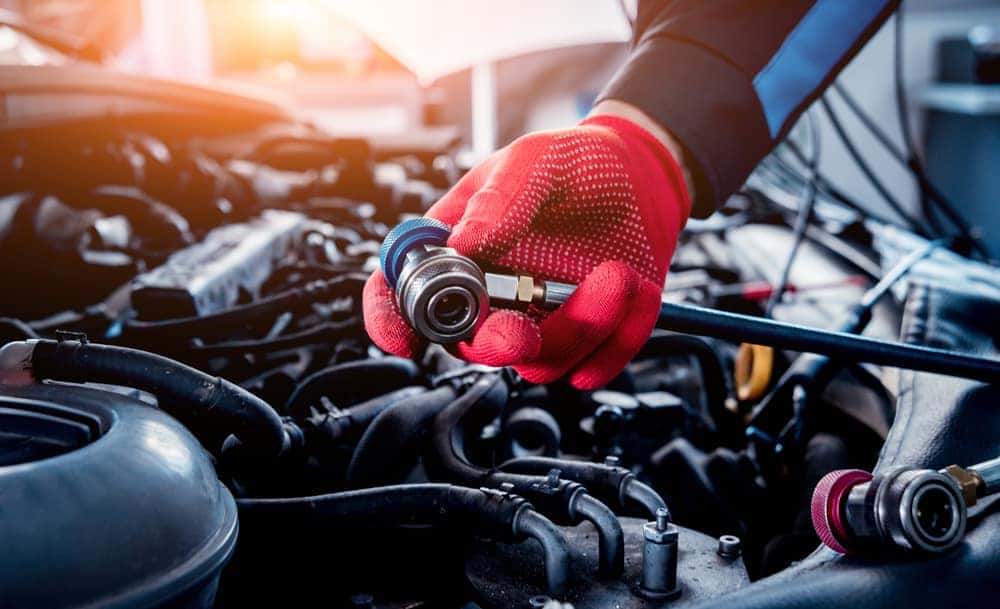
What are the main parts of my car’s air conditioning?
Your vehicle’s air conditioning has several parts that make the cabin air cold.
These parts include:
- The compressor. This part pressurizes the refrigerant, and it also monitors temperature changes through the compressor’s clutch. It’s powered by the serpentine belt.
- The condenser. The air conditioning condenser is in front of the main radiator. It radiates the refrigerant’s hot gasses that come from the compressor, lowering the temperature and pressure, which converts the refrigerant to a liquid.
- Receiver/dryer. Next, the refrigerant goes to the receiver/dryer. This part removes moisture from the cold air using desiccant packs. It also filters out contaminants.
- Accumulator. Found on some cars’ air conditioners, the accumulator controls the amount of refrigerant that enters the evaporator. It’s similar to the receiver/dryer.
- Thermal expansion valve or orifice tube. This part is between the condenser and evaporator. It monitors the pressure in the system to measure the exact amount of refrigerant that can enter the evaporator.
- Evaporator. The evaporator cools the refrigerant and removes moisture from the air. It’s right behind your dashboard.
- Compressor clutch. An electromagnetic clutch that engages and disengages the compressor’s cycle of pressurizing and depressurizing the refrigerant. It uses the clutch cycling switch to control the temperature of the evaporator core to prevent it from freezing.
- Refrigerant charge port. If your air conditioning needs to recharge, this is the spot where a technician will add more refrigerant.
How much does car air conditioning maintenance cost?
Maintenance for your car’s air conditioning may cost anywhere from $100 to $4,000 or more, depending on what’s wrong with it and what parts you may need to buy for it.
Who can perform maintenance on my car’s air conditioning in Springfield, Missouri?
Make an appointment with the certified technicians at Thompson Sales in Springfield, Missouri. Our team can work on your air conditioning and get it back to top form as soon as possible.
0 comment(s) so far on Car Air Conditioning FAQs