


Tire Balancing FAQs

Tire balancing represents vital maintenance your vehicle may need occasionally. Unlike regular car maintenance or tire rotation service, there is no set time or mileage for balancing your tires. Thompson Sales explains with our tire balancing FAQs.
What does tire balancing do for your vehicle?
Tire balancing service ensures the weight of each tire is evenly distributed around the wheel, so they work properly to maintain smooth rolling of each tire and a smooth ride. Properly balanced tires lead to longer tire life.

What causes tires to be out of balance?
Four main things can cause a tire to become out of balance with its wheel.
Cold Temperatures
As the weather turns colder, your tires may deflate slightly because the air doesn’t expand very much. Sometimes, your tire might deflate so much that it causes your tires to become out of balance.
Loss of a Tire Weight
Each tire on your vehicle has weights that balance out minor, tiny imperfections in the construction of the rubber tire. When your tire hits a pothole, speed bump, curb, or an object in the road, the collision could cause one of the weights to fall off.
Uneven Wear
Uneven wear comes from not rotating your vehicle’s tires regularly, improper alignment of the tires, overinflation, underinflation, or worn out suspensions. Uneven wear on your tire might cause your tire to dip slightly to one side or the other, which may cause your tire to wear out even faster.
Parking for Extended Periods
Leaving your car parked for extended periods without moving it might lead to flat spots in your tires. These flat spots could develop into an out-of-balance tire.
How do I know if my car needs tire balancing?
Common symptoms of out-of-balance tires include:
- Vibration in the steering wheel, floorboard, or seat that gets worse as you drive faster than 50 mph
- Faster tread wear
- Strange noises coming from your vehicle, such as humming and buzzing that get louder as you go faster
- Poor fuel economy
- Unusual tire wear patterns.
If the imbalance happens in the front, you might feel the vibration in the steering wheel. If a tire imbalance occurs in a rear tire, the vibration could happen in the floorboards.
What happens during tire balancing service?
A few steps go into tire balancing at Thompson Sales.
- A technician mounts a single tire and wheel assembly on a particular tire balancing machine, called a tire balancer, in the service department of Thompson Sales.
- This machine spins the tire and wheel together as it takes measurements.
- The machine senses the vibrations in the tire in two different directions.
- After making calculations, the tire balancer tells the technician if the weight is spread evenly across the tire. It will then tell the tech how much weight to add, where to add it, or how to adjust the weights already on the wheel.
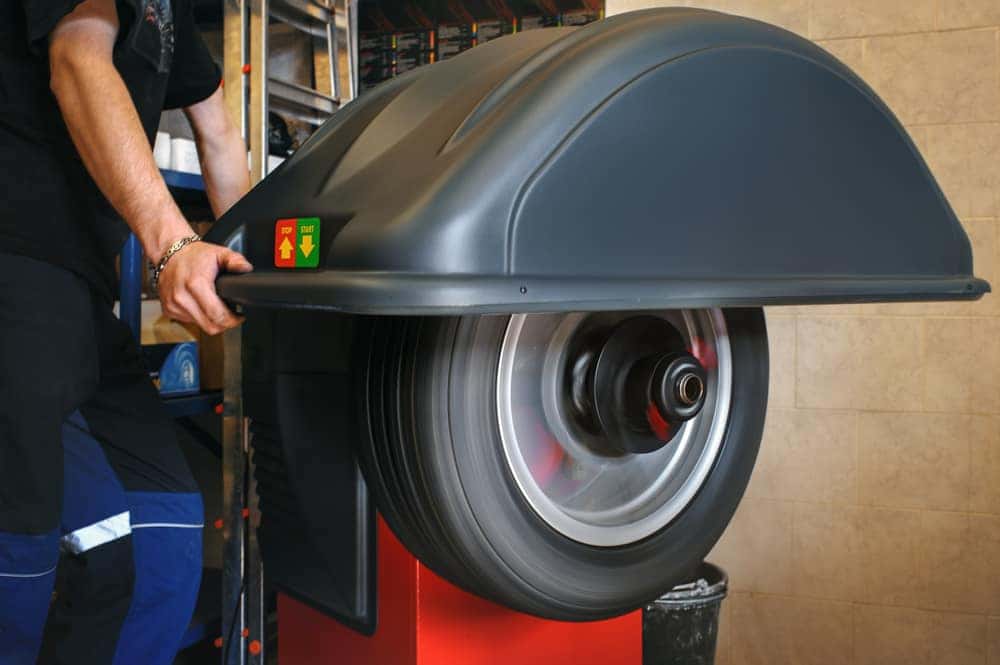
How does a tire balancer work?
A particular machine spins the wheel at around 60 MPH for a minute or two. Meanwhile, the shaft on which the wheel sits is calibrated to sense vibrations in the assembly. A computer displays how much weight to add while showing where the technician should add the consequences. After our technician applies the weights, the tire balancer reruns the same test to see if the weights corrected the vibrations.
How often should I get my car’s tires balanced?
There is no prescribed timeframe for balancing your car’s tires. It’s a good idea to pair a tire rotation with a tire balancing service to make sure your tires run smoothly. When you get new tires on your vehicle, the technician will balance the tires for you as part of the installation.
Most manufacturers recommend tires go through rotation and balancing every 7,500 miles.

What kinds of tire weights are there?
There are two different types of tire weights technicians can use on your tires.
Clip-on tire weights.
These weights clip securely to the wheel right where the tire meets the rim. It takes a somewhat strong force to dislodge a tire weight, such as hitting a pothole or curb. Special pincers secure each weight to the rim.
Adhesive tire weights.
Adhesive tire weights attach to the inside of the rim. A technician peels off the backing away from a small strip of weights before attaching the weights to a plastic wheel rim.
What is the difference between tire balancing and wheel alignment?
Both tire balancing and wheel alignment may have similar symptoms, but technicians solve these problems differently.
Tire balancing occurs when a technician adds more weight to a tire.
Wheel alignment happens when a technician straightens out the metal wheels to drive in the same direction.
How much does tire balancing cost?
Tire balancing costs anywhere from $15 to $75, depending on the vehicle, tires, and how many tires need balancing.

Is it wrong to drive on out-of-balance tires?
Yes. Out-of-balance tires might cause damage to several parts of your vehicle, including:
Damaged shocks due to increased stress on them. Broken shocks can lead to a damaged axle.
Broken wheel bearings can lead to your wheel being unable to turn or harder to turn. This could cause friction build-up in wheels and damage them permanently.
Do all tires need to be balanced?
Yes, all new tires need to be balanced when a technician installs them on your vehicle, regardless of the brand or size, without exceptions.
Why do tires need to be balanced?
All tires must be balanced because of minor imperfections in the rubber of the tires that occur during the manufacturing process. Balancing tires makes your vehicle run more smoothly, and it’s necessary for every new tire.
Where can I get my car’s tires balanced in Springfield, MO?
Make an appointment with Thompson Sales, and we’ll balance your tires. Call us at (417) 763-6811 for more information.
0 comment(s) so far on Tire Balancing FAQs